ELYSAS MUSE PRIME: Why Seven Focal Lengths Must Work as One Cinema-Lens System
Beyond a single lens's sharpness, MUSE PRIME's seven-focal-length design asks whether coverage, exposure, focus behavior and on-set mechanics remain coherent through an entire production.
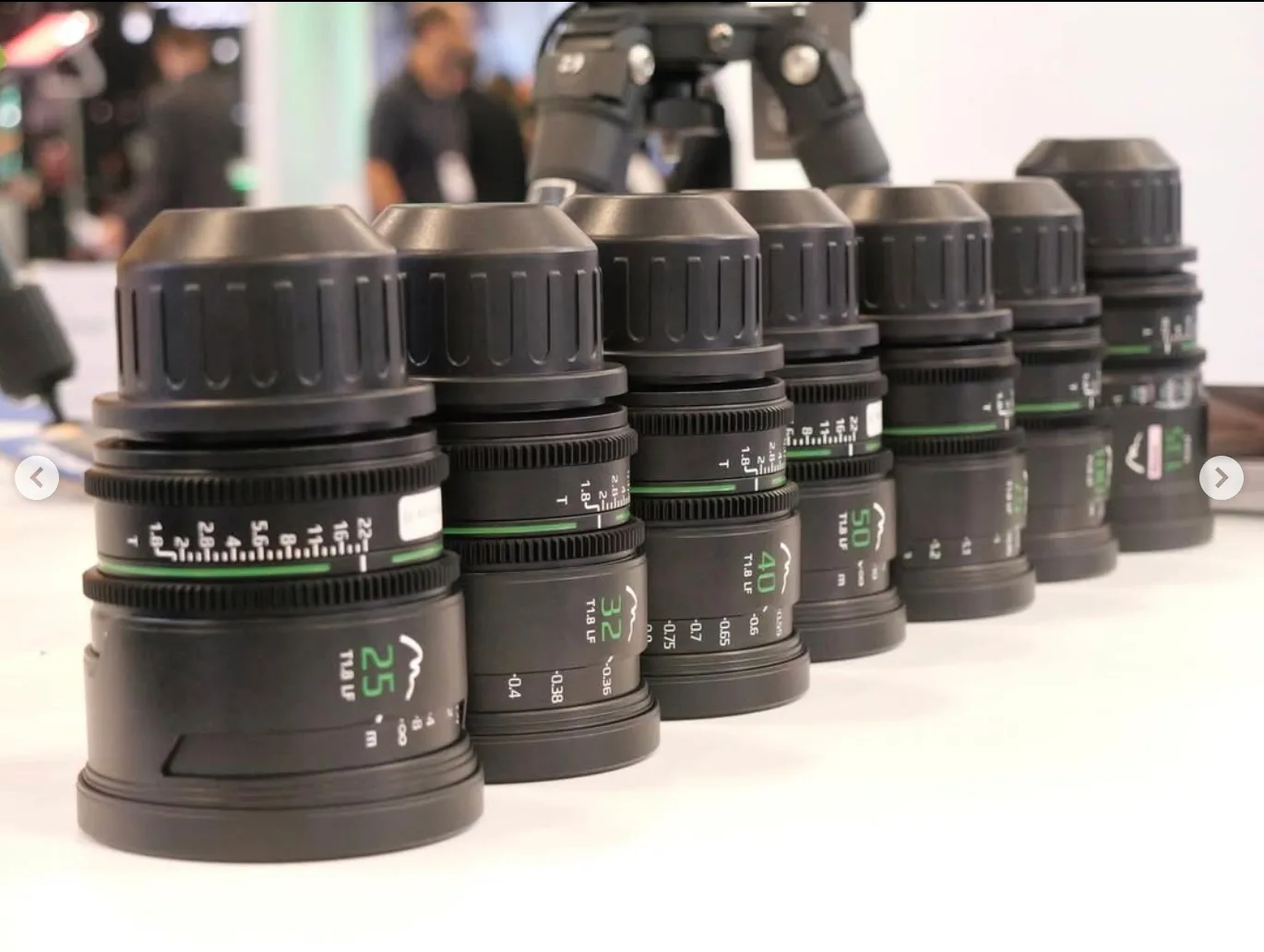
MUSE PRIME lens family. Previously supplied author photograph; image is illustrative, not an independent optical test.
GLOBAL IMAGING BRIEF
Why it matters
For cinematographers and rental teams, the relevant purchase decision is not a best-case image from one focal length. It is whether the set preserves framing, exposure, handling and an intentional image character across cameras and shooting distances. The specifications discussed are manufacturer-published; project-specific performance should be verified in a lens test.
Full perspective
A cinema prime is rarely chosen in isolation. A production changes focal length, moves between full-frame and cropped recording modes, pulls focus, swaps filters, balances a gimbal and matches shots made days apart. A lens set earns its place when those changes do not force the crew to rebuild the visual language or the camera package. That is a more useful starting point for examining ELYSAS and its MUSE PRIME series than a single chart of maximum resolution.
According to the brand's own account, ELYSAS is the professional cinema-lens brand of UNIOPTIX (Shenzhen). Its name draws on Elysium, and its stated ambition is to let engineering support rather than dominate visual expression. MUSE PRIME is the tangible test of that idea: six T1.8 primes from 25 mm to 100 mm, plus a 135 mm T2.8 Macro. The question for a working crew is how convincingly these seven tools behave as one system.
A 50 mm lens in a camera rig. Previously supplied author photograph.The 100 mm configuration. Previously supplied author photograph.
01
Brand story: the lens as a quiet instrument
ELYSAS describes an integrated optical and mechanical development approach through UNIOPTIX. That is a manufacturer statement about its organization, not an independently audited factory assessment. The meaningful connection to filmmaking is the design brief: image character is considered alongside resolution, mass, ergonomics and repeatability. A beautiful single frame is not enough if a lens is cumbersome to build into a working camera or differs abruptly from the next focal length.
The company calls its intended rendering Melted Bokeh. This article does not treat the phrase as a measured optical specification. It describes the manufacturer's aesthetic aim: preserve useful detail at the plane of focus while shaping the transition into defocus. Crews should test that aim with people, practical lights and backgrounds at the distances and apertures used in their own projects; no promotional still can substitute for that comparison.
02
The seven-focal-length map
The published lineup is 25, 32, 40, 50, 75 and 100 mm at T1.8, with a 135 mm Macro at T2.8. The six core lenses maintain the same stated maximum T-stop, which makes an exposure strategy easier to carry across coverage, dialogue, portrait and detail shots. The macro is deliberately different: it provides continuous focus from infinity to 1:1 for inserts and small subjects, but its T2.8 transmission must be accounted for when a sequence cuts to the faster lenses.
Focal-length coverage matters because a set must offer usable steps rather than simply a wide endpoint and a long endpoint. The 32 and 40 mm positions give operators intermediate choices around subject perspective and camera distance; the 75 and 100 mm positions help refine portrait compression and working distance. None is inherently the right choice for a scene. A practical lens test should repeat the same subject framing with multiple focal lengths and record camera position, focus distance and background geometry.
03
Coverage is a geometry question, not a slogan
ELYSAS specifies a 46.5 mm image-circle design standard for the series and says usable coverage can extend farther in some formats. That standard is a clear starting point for full-frame and comparable large-format camera planning. It is not a promise that every sensor mode, stabilization crop or outer-field composition will have identical brightness and image character. Sensor diagonal, recording window, aspect ratio, intended reframing and the actual corner performance all matter.
A sensible prep test places important detail and bright points near the frame edge, then repeats the shot at working T-stops and across the camera modes to be used. That reveals vignetting, off-axis definition, color shading or rendering changes that a centered chart can miss. The point is not to demand a perfectly uniform image, but to know where the lens's character becomes a creative choice and where it creates an avoidable post-production problem.
04
Focus pulls and the breathing caveat
The product table lists a breathing effect below 2% from infinity to close focus for the 25–100 mm lenses. That is a manufacturer-published figure, not our measurement, and the visual prominence of breathing depends on framing, subject distance and focus path. For a dialogue rack focus, the relevant question is whether a change in field of view calls attention to itself. Testing should therefore use the same move speed and endpoints anticipated on set, not only a static before-and-after frame.
The 135 mm Macro requires a separate reading. ELYSAS lists approximately 3% breathing from infinity to 0.1× magnification and about 17% from 0.1× to 1×. Large changes at true macro magnification are not interchangeable with the normal-distance specification of the other primes. A production planning a moving macro focus should budget for the visible scale shift in blocking and composition, and should test its own camera/lens combination before making an intercut promise.
05
Mechanical consistency saves more than seconds
Across the series, ELYSAS publishes a 95 mm front diameter, 86 mm filter thread, standard 0.8 MOD gears and consistent focus/iris gear positions. The six non-macro primes are also listed at 98.5 mm from mount to front, while the 135 mm Macro is longer. Those dimensions matter to matte-box position, motor mesh, remote-head clearance and gimbal balance. A consistent interface can reduce resets, but teams should still verify the precise mass and length of each lens before assuming a no-rebalance swap.
All seven PL-mount versions are listed below 0.9 kg; the LPL weights are not all below that threshold. The distinction is operational rather than rhetorical: a crew budgeting a light gimbal or drone payload should use the weight of the chosen mount version, with filters, motors and matte box attached. The published 270° focus travel and PL/LPL mount options are useful planning inputs, but mount clearance and lens-data needs must still be checked against the camera and accessories on the actual job.
06
How to evaluate a set before the shoot
A useful evaluation has three layers. First, technical compatibility: inspect the recording window, mount, flange, filter path and accessory package; measure exposure, edge response and focus behavior at working distances. Second, image continuity: shoot the same face, fabric, practical lights and background through multiple focal lengths at matched framing and exposure. Third, on-set operation: repeat the lens swap with the actual focus motors, matte box, stabilization mode and camera assistant workflow. This separates a laboratory-friendly specification from a production-friendly system.
Record the camera model, sensor mode, stop, subject distance, focus endpoints and color workflow for every comparison. Review full-resolution motion clips, not only graded stills. The desired look may depend on lighting and production design as much as on optics; a supplier's sample image should be treated as a starting hypothesis. A rental house or cinematographer should ask for repeatability across serial numbers and for practical support when a set must remain matched over time.
07
Where the story goes next
MUSE PRIME offers a coherent published proposition: seven focal lengths, six matching T1.8 core primes, a separate 1:1 macro, large-format design coverage and standardized cinema mechanics. ELYSAS frames this as an image-character-led system rather than a race for the highest number on one chart. That is a legitimate design direction, but its value for a particular film must be established in the camera, lighting and movement conditions of that film.
This Lens Journal will examine one practical question per edition rather than recycle launch claims: defocus transition, the 135 mm Macro, focus breathing, off-axis coverage, lens matching and camera-package ergonomics are all separate subjects. For a project evaluation, ELYSAS's official dealer and contact pages provide routes to arrange a hands-on lens test. Share the camera format, focal lengths, working distances, intended look and support needs before deciding whether the system belongs on a production.
Original source
Independent technical analysis based on ELYSAS's public product and company pages. Product figures are manufacturer specifications dated 21 April 2025, not measurements by GLOBAL IMAGING BRIEF. Photographs were previously supplied by the author. First published 27 October 2026; this is not a claim of a new product launch today.