MUSE PRIME 40mm: Camera Distance, Perspective and the Mid-Wide Frame
The MUSE PRIME 40mm sits between the 32mm and 50mm in the same T1.8 series. At a fixed camera position, changing focal length changes framing, not perspective; matching subject size instead requires the shorter lens closer and the longer lens farther away. This guide uses ELYSAS's published specifications as a starting point and sets out practical camera and focus tests without claiming an independent optical measurement.
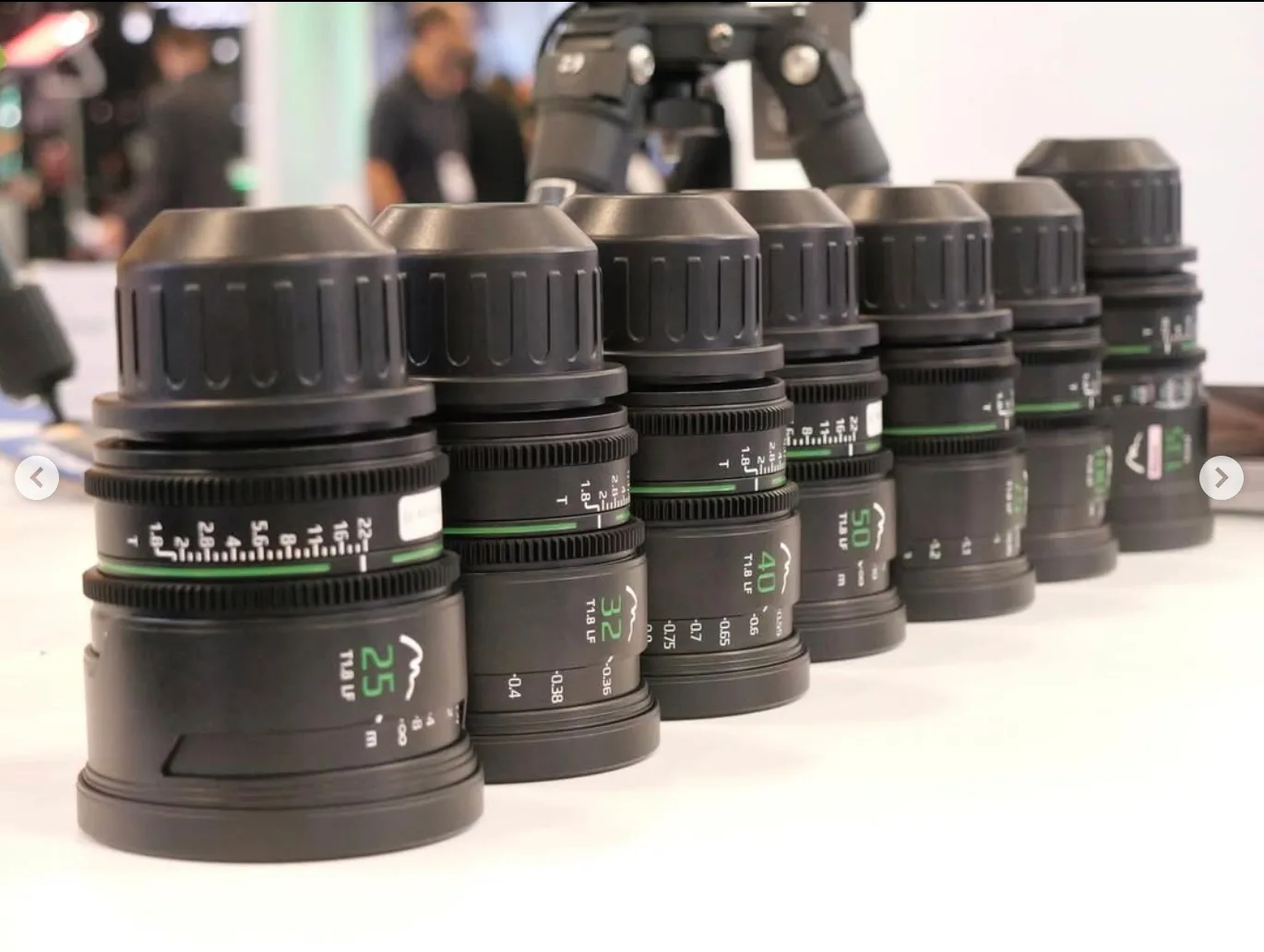
MUSE PRIME lens family. Previously supplied author photograph; illustrative product image, not an independent 40mm optical test.
GLOBAL IMAGING BRIEF
Why it matters
For cinematographers, the 40mm choice is primarily about the relationship between subject scale, camera position and visible environment. A focal-length label alone cannot predict facial proportions, background size or bokeh. Rental teams should test the 32/40/50mm trio at a fixed viewpoint and again with matched subject framing, while checking close focus and rig clearance on the intended camera.
Full perspective
A 40mm cinema prime is often chosen when a scene needs a person to remain prominent without surrendering the space around them. That description is a framing preference, not a physical property unique to 40mm. The geometry must be stated precisely: from one camera position, a 32mm lens includes more of the scene than a 40mm, while a 50mm includes less. Cropping those fixed-viewpoint images to the same subject size preserves perspective. Perspective changes only when the camera position changes relative to the people and background.
ELYSAS lists the MUSE PRIME 40mm as a T1.8 lens within a seven-focal-length cinema series. Its published table specifies a 46.5mm design image circle, a 61-degree diagonal angle of view, 400mm minimum object distance measured from the sensor plane, a 95mm front and PL/LPL mount options. Those are manufacturer specifications, not this publication's measurements. The product was publicly introduced in 2025; this Nov. 1 article is a technical examination, not a new launch.
01
Separate field of view from perspective
At a fixed tripod mark and sensor format, focal length sets the angular field and therefore the amount of background admitted to the frame. ELYSAS quotes diagonal fields of 73 degrees for its 32mm, 61 degrees for 40mm and 49.4 degrees for 50mm, under the company's specified image-circle basis. The figures help plan coverage but do not tell you how large a face will look after cropping, or what happens when the camera moves. Keep sensor crop, aspect ratio and stabilization crop constant during a comparison.
If the camera is locked and the actor does not move, changing from 40mm to 32mm widens the frame; changing to 50mm tightens it. A face's relative proportions and the position of background objects remain set by the same viewpoint, apart from lens-specific distortion and focus-dependent rendering. Claims that focal length itself 'compresses perspective' confuse the framing choice with the camera movement commonly made to restore subject size.
02
Match subject scale, then watch the camera move
To hold a person's height roughly constant in frame on the same sensor, a shorter focal length generally calls for a closer camera and a longer focal length for a more distant camera. In a 32/40/50mm test, the 32mm position will normally be closest to the actor, 40mm in between and 50mm farthest. That change in viewpoint makes nearby features and objects relatively larger at the shorter-lens position and changes how much of a distant background appears behind the subject. The exact distances depend on framing and focus geometry, especially at close range.
Run two tests rather than one. First lock the camera and switch lenses to isolate framing and lens rendering. Then move the camera for matched subject size to reveal the perspective change that a working cinematographer would actually create. Record camera-to-subject and subject-to-background distances, focus setting, iris and sensor crop. Without those notes, a still from a different focal length can be mistaken for evidence of an intrinsic lens 'look' when it is mostly evidence of a changed shooting position.
03
Use close-focus figures correctly
ELYSAS states the 40mm minimum object distance as 400mm from the sensor plane and 260mm from the front element. Those are two references for the same close-focus condition, not two separate focusing modes. The corresponding company figures are 350mm/210mm for 32mm and 500mm/360mm for 50mm. A camera body, mount adapter, matte box and front filter all consume physical clearance, so the front-element number alone is not a safe lens-to-subject clearance in a moving shot.
For a tight dialogue shot, test whether the desired composition can be reached without crowding an actor, casting an unwanted camera shadow or blocking practical light. A closer 32mm position may change both facial perspective and lighting logistics; a farther 50mm position may simplify working space but narrow the environment shown. The 40mm is a middle option in this set, not a universally optimal distance.
04
Judge focus falloff without a shortcut
Background blur depends on entrance pupil, focus distance, subject-to-background spacing, sensor format and the final display size; aberration balance also changes the shape and edge of defocused highlights. Perspective and blur are related through shooting choices but are not the same phenomenon. A 50mm image made from farther away for matched subject size does not automatically have 'more blur because of perspective compression.' Compare the same T-stop and keep the background location documented; then inspect point lights, hair edges and depth transitions at center and off axis.
ELYSAS calls its rendering approach Melted Bokeh and describes a gradual transition from the focused plane into defocus. That is a manufacturer description of intended image character, not a quantified result from this publication. Test it with a repeatable scene: a face or textured object at the focus plane, foreground and background targets at known distances and practical point sources near the frame edge. Review full-resolution footage rather than only compressed social-media clips, and note whether the character remains coherent when cutting between 32, 40 and 50mm.
05
Read breathing claims within their test interval
The ELYSAS table lists less than 2% breathing from infinity to close focus for each 25-100mm MUSE PRIME. It is a published specification, not a guarantee that every focus pull on every camera will look identical. A single endpoint percentage does not show where in the throw the framing change happens, whether it is monotonic, or how distortion and field edges evolve. Mark several focus distances, pull in both directions and compare a fixed background grid on the intended sensor crop.
The 40mm has a 270-degree published focus rotation, a useful starting point for manual marks and motor mapping. It does not prove the shape of the distance scale or repeatability of a particular unit under temperature change. Test with the chosen follow-focus motor and monitor, especially when a shot moves from a close actor to a distant environment. Report lens markings, measured focus position and observed image-scale change separately.
06
Check format and mechanical integration
The 46.5mm image circle is ELYSAS's design standard. Its statement that usable coverage may extend beyond that standard does not promise equal sharpness, illumination or flare control at every outer pixel of every larger sensor. On the intended camera, test the exact recording mode, aspect ratio, stabilization margin and focus distances; evaluate corner falloff and shading at T1.8 as well as at a working stop. A small crop or different open-gate mode can change whether the outer field is acceptable.
ELYSAS lists a common 95mm front, 86mm filter thread and shared focus/iris gear positions across the series. The published PL-mount 40mm weight is 843g and the LPL version 893g; series-wide 'under 0.9kg' wording applies to PL configurations, not every LPL lens. Verify the actual mount, matte-box clearance, motor spacing and balance with the production unit. Identical front diameters reduce accessory changes but do not eliminate rebalancing when camera, support or lens mass changes.
07
Questions for a lens test and rental decision
Ask whether the test set includes the same mounts and optical configuration as the intended rental units. Film a fixed-viewpoint comparison and a matched-subject-size comparison; include close-focus marks, a focus pull, practical highlights and a bright source outside the frame. Check color and contrast continuity across the 32/40/50mm trio, and document camera settings so a later editorial choice is reproducible. Custom coating or optical tuning is described by ELYSAS as project-dependent and should not be assumed to be standard on a dealer sample.
The useful value of a 40mm is not a promise that it always looks natural. It is a specific field-of-view option within a mechanically coordinated lens set. Its suitability emerges from the scene, camera position, actor distance, background and intended edit. ELYSAS's official dealer directory provides a route to view or test MUSE PRIME; request a current sample and evaluate the rendering yourself rather than treating published specifications as measured performance on your production.
Original source
Original technical analysis based on ELYSAS's MUSE PRIME product page and published specification table, updated April 21, 2025. Focal-length and perspective explanations are general imaging geometry; product dimensions and breathing figures are manufacturer statements, not independent measurements. Existing article photograph was supplied previously by the author. This is not a new-product announcement.